
A gel polish UV light cures special nail coatings that cannot harden correctly through air drying alone. The lamp activates light-sensitive ingredients inside the formula, creating the durable finish associated with gel manicures. Modern LED nail lamps also use ultraviolet wavelengths, although they often cure compatible products faster.
Quick answer: Gel nail products usually need a compatible UV or UV-LED lamp to cure correctly. Traditional UV lamps often require longer exposure, while modern LED systems commonly cure compatible layers faster. Always follow the polish manufacturer’s stated lamp type and curing time rather than relying on wattage alone.
| Question | Practical answer |
|---|---|
| Does gel polish need a lamp? | Most true UV-curable gel products require a compatible nail lamp. |
| Is an LED lamp still UV? | Yes. Nail-curing LEDs normally produce targeted ultraviolet wavelengths. |
| How long does curing take? | Often 30–60 seconds with compatible LED systems, but products vary. |
| Can regular polish use a UV lamp? | Regular air-dry polish does not need ultraviolet curing. |
| Is lamp exposure risk-free? | No. Exposure is usually brief, but UV protection can reduce unnecessary exposure. |
| What matters most when choosing a lamp? | Compatibility with the exact nail product and manufacturer instructions. |
How Does a Gel Polish UV Light Work?
Gel products contain photoinitiators that react when exposed to specific wavelengths of ultraviolet energy. That reaction changes the liquid coating into a hardened polymer layer. Regular nail lacquer works differently because its solvents evaporate into the air. A lamp must produce wavelengths that match the photoinitiators used in the product. This explains why a lamp can appear powerful yet still cure certain formulas poorly.
Manufacturer compatibility matters more than choosing a device based only on its advertised wattage. Some traditional lamps use fluorescent UV bulbs across a broader wavelength range. Modern UV-LED units concentrate their output within narrower ranges and often work faster. Research and manufacturer information commonly place nail-lamp emissions largely within the UVA range.
UV Versus LED Nail Lamps
The terms “UV lamp” and “LED lamp” often create unnecessary confusion. Both types can expose your hands to ultraviolet radiation during nail curing. The main difference involves the technology producing that radiation and the wavelengths delivered. Older fluorescent-style UV lamps generally expose each layer for a longer period.
Compatible UV-LED systems can often finish a layer in roughly 30 to 60 seconds. Traditional systems may require around two minutes or longer for some formulas.
| Feature | Traditional UV lamp | UV-LED nail lamp |
|---|---|---|
| Light source | Fluorescent-style bulbs | Light-emitting diodes |
| Typical curing speed | Slower | Usually faster |
| Wavelength output | Broader range | More targeted range |
| Product compatibility | Often broad, but formula-dependent | Requires compatible photoinitiators |
| Bulb replacement | May be required | Usually less frequent |
Neither category guarantees compatibility with every manicure product. A surface can look hardened even when deeper material remains insufficiently cured. Using the lamp recommended by the product maker reduces that problem.
How Long Should Gel Polish Cure?
There is no universal curing time for every gel formula. Lamp wavelength, formula chemistry, coating thickness, color, and hand placement can change the required exposure. The printed instructions for your exact product should therefore take priority. Many compatible UV-LED systems use cycles around 30 to 60 seconds for thin coats. Some traditional lamps can require two or three minutes for particular products.
These ranges are useful references, but they should not replace product directions. Applying thick coats can also interfere with proper curing. Keep layers thin, even, and free from skin contact around the nail. Place the whole hand where the lamp manufacturer directs, including the thumb when required.
Why Lamp Compatibility Matters
A common mistake is assuming that more wattage automatically means better curing. Wattage mainly describes electrical power and does not fully describe useful light reaching the product. Wavelength, diode position, exposure time, and formula design also matter. Incorrect curing may leave reactive ingredients inside material that appears solid. Nail professionals have long warned that visible hardness does not always confirm complete curing.
Using a tested product-and-lamp combination offers a more reliable approach. Avoid extending exposure repeatedly because a layer still seems wrong. First check layer thickness, product instructions, lamp condition, and formula compatibility. Persistent curing problems usually deserve troubleshooting rather than another random timer cycle.
Is UV Light for Gel Nails Safe?
Nail lamps generally expose the hands to UVA during relatively short sessions. Current research has not established a clear causal link between typical nail-lamp use and skin cancer. Still, laboratory studies and exposure research provide reasons to limit unnecessary ultraviolet exposure.
A 2025 scoping review examined studies, case reports, surveys, and experimental evidence involving nail lamps. The authors found that measured exposure varied substantially among devices. They concluded that available evidence remains insufficient to establish a direct causal relationship with carcinoma.
UV radiation itself can contribute to premature skin aging and skin cancer after cumulative exposure. The FDA notes that UVA and UVB can damage skin. Your total risk depends on exposure patterns and individual factors.
Readers interested in broader wellness and skin-related topics can also browse NewspaperLA’s Health coverage. NewspaperLA Health section NewspaperLA also covers appearance and lifestyle subjects within its Fashion section. NewspaperLA Fashion section
Ways to Reduce UV Exposure During a Gel Manicure
The American Academy of Dermatology recommends broad-spectrum, water-resistant SPF 30 or higher before a gel manicure. Dermatologists also suggest dark, opaque fingerless gloves as another option. These steps reduce unnecessary radiation reaching the skin around your nails.
Apply sunscreen to exposed hand skin before using the lamp. Avoid coating the nail plate if your nail-product instructions require a clean surface. Protective gloves should leave only the nail area uncovered. People taking photosensitizing medications may need additional caution. The FDA notes that certain medicines and cosmetics can increase sensitivity to ultraviolet radiation.
Ask a healthcare professional when you are uncertain about a medication or skin condition. For related reading about skin appearance and care, see NewspaperLA’s article about marine collagen and skin texture. Marine collagen and skin texture. It covers a different topic, but it fits readers exploring broader beauty and skin-care information.
How to Cure Gel Nails Correctly at Home
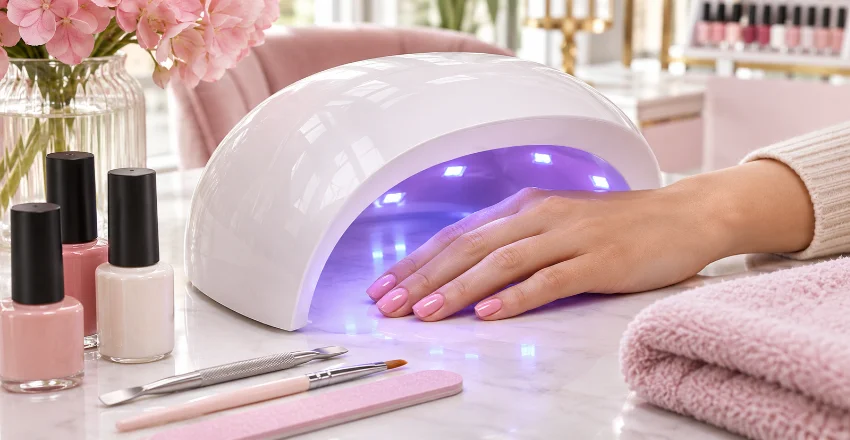
A successful home manicure depends more on consistency than extra lamp exposure. Prepare the nail according to the product instructions and keep uncured material away from surrounding skin. Thin coats generally cure more evenly than thick applications.
1. Prepare and clean the nail according to the gel system’s directions. 2. Apply the recommended base layer in a thin, controlled coat. 3. Cure for the exact time specified by the product manufacturer. 4. Apply a thin color coat without flooding the cuticle or sidewalls. 5. Cure again using the specified compatible lamp setting. 6. Repeat the color layer only when the formula requires another coat. 7. Apply the recommended top coat and complete its stated curing cycle. 8. Finish or remove any inhibition layer according to the product directions.
Do not assume a sticky surface always means an uncured manicure. Certain products intentionally leave an inhibition layer that requires cleansing after curing. The manufacturer’s directions should explain whether that layer is expected.
Common Mistakes to Avoid
Using incompatible products and lamps is one of the biggest avoidable problems. Another is applying coats so thickly that light cannot cure them evenly. Guessing cure times can also produce inconsistent results between manicures. Do not use a lamp designed for unrelated UV applications. Nail lamps are intended for compatible cosmetic curing systems.
Follow the equipment instructions, and never stare directly into a strong ultraviolet source. Picking or peeling cured material can also damage the natural nail surface. The American Academy of Dermatology recommends proper removal instead of pulling the coating away. Repeated aggressive removal can contribute to brittleness, peeling, and cracking.
Frequently Asked Questions About Gel Polish UV Light
Does gel polish dry without UV light?
Most true UV-curable products will not harden correctly through ordinary air drying. Their formulas need specific light energy to trigger polymerization. Regular nail lacquer remains the better choice when you want an air-dry product.
Is LED safer than a traditional UV lamp?
UV-LED units normally cure compatible products faster, which can reduce total exposure time. The American Academy of Dermatology notes that LED systems emit lower UV levels and cure faster than traditional UV curing lights. They still produce ultraviolet radiation, so sensible skin protection remains reasonable.
Can any UV lamp cure any gel?
No lamp should be assumed compatible with every formula. Different products use photoinitiators that respond to particular wavelength ranges. Check the manufacturer’s lamp requirements before starting your manicure.
How often can you use a nail lamp?
There is no universal schedule that applies to everyone. Less frequent exposure naturally reduces cumulative ultraviolet exposure compared with repeated sessions. People with skin concerns should discuss their manicure habits with a dermatologist.
Should you wear sunscreen under a nail lamp?
Dermatologists recommend broad-spectrum, water-resistant SPF 30 or higher on exposed hand skin before a gel manicure. Fingerless opaque gloves provide another protective option. Neither measure replaces proper product directions or careful lamp use.
The Bottom Line
A gel polish UV light works by activating photoinitiators that harden compatible nail coatings. UV-LED lamps often cure faster, but no lamp should be treated as universally compatible. Matching the formula, wavelength requirements, and specified cure time matters most. Current evidence does not prove that typical nail-lamp use directly causes skin cancer. Still, lamps emit ultraviolet radiation, and you can reduce unnecessary exposure.
Sunscreen, fingerless protective gloves, and correct curing procedures offer practical precautions. For an at-home manicure, read both the polish and lamp instructions before starting. Stop guessing when a product fails to cure correctly, because extra exposure may not solve incompatibility. Correct product matching produces better results while keeping exposure as limited as practical.

